

Sep . 12, 2025 10:20 Back to list
Precision Pump Shafts: High-Quality & Durable Solutions for Water Pumps.
Understanding the Critical Role of Pump Shafts in Industrial Operations
In the intricate world of industrial fluid dynamics, the pump shaft stands as a linchpin, a fundamental component responsible for transmitting power from the motor to the impeller, thereby enabling the movement of fluids. Its integrity directly impacts the efficiency, reliability, and longevity of pumping systems across a multitude of sectors. This comprehensive guide delves into the technical intricacies, manufacturing excellence, application diversity, and strategic considerations surrounding these vital components, offering insights for B2B decision-makers and engineering professionals.
From high-pressure petrochemical installations to municipal water treatment plants and the demanding environments of metallurgy, the performance of a pump is only as robust as its shaft. Our analysis will cover industry trends, technical specifications, diverse application scenarios, and the distinct advantages that precision-engineered shafts offer, culminating in a detailed look at vendor capabilities and customization options.
Global Industry Trends and Market Dynamics
The market for industrial pumping solutions is witnessing continuous evolution, driven by increasing demand for energy efficiency, stringent environmental regulations, and the need for enhanced operational reliability. This translates directly into higher expectations for the pump shaft. Key trends include:
- Advanced Materials Science: A shift towards super duplex stainless steels (e.g., UNS S32750, S32760), nickel-based alloys, and advanced ceramics for improved corrosion resistance, higher strength-to-weight ratios, and extended service life in aggressive media and extreme temperatures.
- Precision Manufacturing & Miniaturization: Growing emphasis on tighter tolerances, superior surface finishes, and innovative designs (e.g., hollow shafts) to reduce weight, minimize vibration, and improve overall pump efficiency.
- Digitalization and Predictive Maintenance: Integration of sensor technologies and IoT for real-time monitoring of shaft performance, enabling predictive maintenance strategies and reducing unplanned downtime.
- Energy Efficiency Directives: Global mandates pushing for higher efficiency ratings in industrial equipment necessitate components like shafts that contribute to minimized frictional losses and optimized power transmission.
- Customization Demands: As applications become more specialized, the demand for highly customized shaft designs to meet unique operational parameters is rising significantly.
These trends collectively underscore the critical need for suppliers who can deliver not just components, but integrated solutions that meet the evolving demands of modern industrial infrastructure.
Detailed Manufacturing Process Flow of a High-Quality Pump Shaft
The production of a robust and reliable pump shaft is a multi-stage process, meticulously controlled to ensure adherence to stringent engineering specifications. This workflow integrates advanced metallurgy with precision machining and rigorous quality assurance.
-
Material Selection and Sourcing:
The process begins with selecting the appropriate material based on the shaft's intended application, fluid compatibility, temperature, pressure, and corrosive environment. Common materials include:
- Stainless Steels: AISI 304, 316, 410, 420 for general corrosion resistance and strength.
- Duplex & Super Duplex Stainless Steels: UNS S31803, S32205, S32750, S32760 for exceptional corrosion resistance and high strength, especially in chloride-rich environments.
- Carbon Steels: AISI 1045, 4140 for less corrosive applications requiring good strength and hardenability.
- Nickel-based Alloys: Monel, Hastelloy for highly aggressive chemical environments.
Materials are sourced from certified suppliers, accompanied by Mill Test Certificates (MTCs) to verify chemical composition and mechanical properties.
-
Forging/Casting:
Depending on size, material, and required mechanical properties, the raw material is either forged or cast. Forging (open-die or closed-die) improves grain structure, enhancing strength, toughness, and fatigue resistance. Casting is suitable for complex geometries but may require more rigorous inspection for internal defects.
-
Rough Machining:
The initial stock is turned, milled, and drilled to remove excess material, bringing the shaft closer to its final dimensions. This stage also helps relieve internal stresses from forging/casting.
-
Heat Treatment:
Critical for optimizing mechanical properties. Processes like annealing, normalizing, quenching, and tempering are applied to achieve desired hardness, ductility, tensile strength, and impact resistance. This also refines the microstructure and eliminates residual stresses.
-
Precision CNC Machining:
High-precision CNC lathes and machining centers are used for final shaping, profiling, keyway cutting, threading, and drilling. This ensures accurate dimensions, tight tolerances (e.g., ISO IT6-IT7), and superior surface finishes (e.g., Ra 0.8-1.6 µm) crucial for bearing surfaces and seal areas.
-
Grinding and Polishing:
Bearing and seal journals undergo precision grinding and polishing to achieve exceptionally smooth surfaces and exact diameters, minimizing friction and wear, and extending the life of bearings and mechanical seals.
-
Quality Control & Testing:
Each shaft undergoes rigorous testing in accordance with international standards like ISO 9001, ANSI/API 610, and specific client requirements. This includes:
- Dimensional Inspection: Using CMM (Coordinate Measuring Machine), calipers, and micrometers.
- Material Verification: Spectrographic analysis (PMI), hardness testing (Rockwell, Brinell, Vickers).
- Non-Destructive Testing (NDT): Ultrasonic testing (UT) for internal defects, Magnetic Particle Inspection (MPI) or Liquid Penetrant Inspection (LPI) for surface cracks.
- Dynamic Balancing: For high-speed applications, to minimize vibration.
- Surface Roughness Measurement: Using profilometers.
-
Surface Treatment (Optional):
Coatings like hard chrome plating, ceramic coatings, or nitriding can be applied to enhance wear resistance, corrosion protection, or improve surface hardness for specific demanding applications.
-
Final Inspection and Packaging:
A final comprehensive inspection ensures all specifications are met. Shafts are then typically coated with a rust preventative, securely packaged to prevent damage during transit, and accompanied by full documentation.
This meticulous process guarantees advantages such as superior corrosion resistance, high tensile strength, minimal vibration, enhanced energy saving capabilities, and significantly extended service life, making these shafts ideal for critical operations in target industries like petrochemical, metallurgy, water supply & drainage, power generation, and chemical processing.
Technical Specifications and Key Parameters
The performance and compatibility of a pump shaft are defined by a range of critical technical parameters. Understanding these specifications is essential for selecting the correct component for a given application.
Key Parameters Explained:
- Material Composition: Directly influences corrosion resistance, tensile strength, yield strength, and temperature limits. Specified by ASTM, UNS, or EN standards.
- Diameter & Length: Precisely engineered to fit bearing housings, impellers, and couplings. Tolerances are extremely tight (e.g., ISO h6, h7).
- Concentricity & Runout: Measures the deviation from a perfect circular path during rotation. Low runout (typically less than 0.02mm TIR) is crucial for minimizing vibration and extending bearing/seal life.
- Surface Roughness (Ra): Particularly important for bearing and seal journals. A smoother surface (e.g., Ra 0.4 µm for seals, 0.8 µm for bearings) reduces friction, wear, and leakage.
- Hardness: Indicates resistance to indentation and wear. Measured in Rockwell, Brinell, or Vickers units, often specified after heat treatment.
- Straightness: The degree to which a shaft deviates from a straight line. Critical for smooth operation and prevention of premature wear.
- Keyway/Spline Dimensions: Precise dimensions are required for secure and efficient power transmission to the impeller.
Typical Product Specification Table:
Adhering to these specifications is paramount for ensuring the high performance, durability, and safety of pumping systems, minimizing operational risks and total cost of ownership.
Diverse Application Scenarios
The versatility of the pump shaft allows its application across an expansive range of industries, each presenting unique challenges and demands.
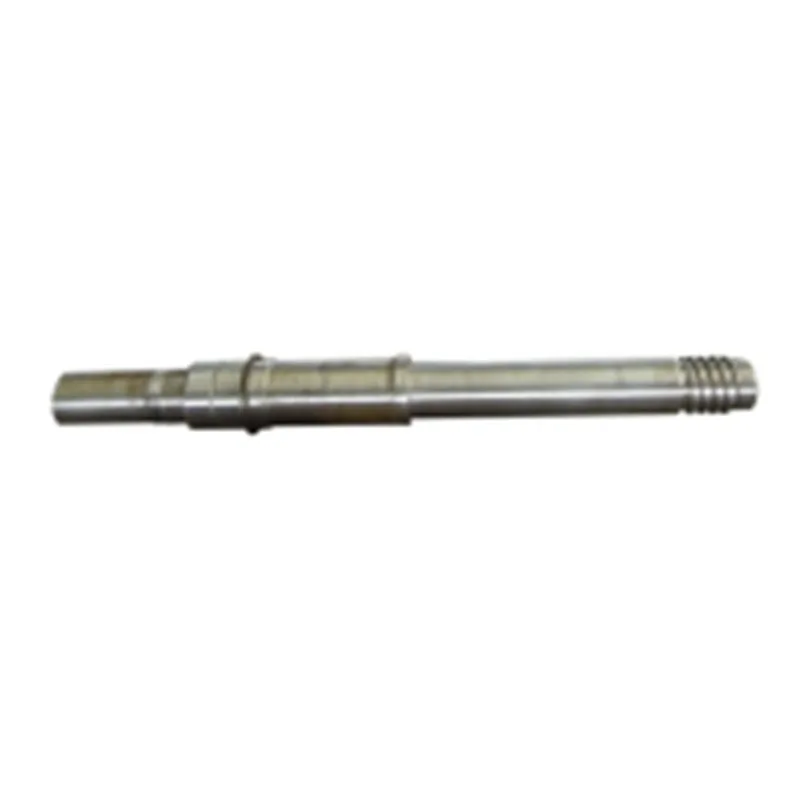
Image: Precision-engineered pump shaft for heavy-duty industrial applications.
- Petrochemical and Oil & Gas: Transporting crude oil, refined products, and various chemicals. Shafts must withstand high pressures, corrosive fluids (e.g., H2S, sour crude), and extreme temperatures, often requiring specialized materials like duplex stainless steels or nickel alloys. Key applications include process pumps, transfer pumps, and injection pumps.
- Water Supply & Drainage: Critical for municipal water treatment, wastewater management, and irrigation. Here, corrosion resistance (especially to chlorine and sewage) and durability against abrasive solids are paramount. The submersible pump shaft, for instance, requires exceptional sealing and material integrity to operate reliably underwater for extended periods.
- Power Generation: Used in cooling water circulation, boiler feed pumps, and condensate extraction. High temperatures, high pressures, and demands for uninterrupted operation necessitate shafts with high fatigue strength and resistance to thermal stresses.
- Mining and Metallurgy: Handling abrasive slurries, corrosive reagents, and high-density fluids. Shafts in these environments require superior hardness, wear resistance, and often protective coatings to resist erosion from solids.
- HVAC and Building Services: Circulating water for heating, cooling, and fire suppression systems. Reliability, minimal vibration, and long service life are crucial for these often continuously operating systems.
- Pharmaceutical and Food & Beverage: Requiring ultra-high cleanliness and strict material compliance (e.g., FDA-approved materials). Stainless steel shafts with highly polished surfaces are essential to prevent contamination and facilitate CIP (Clean-in-Place) processes.
The selection of materials and manufacturing precision for each scenario directly contributes to the operational success and cost-effectiveness of the entire pumping system.
Technical Advantages of High-Performance Pump Shafts
Investing in high-quality pump shaft components yields significant operational and economic advantages, directly impacting the bottom line for industrial clients.
- Extended Service Life & Reduced Downtime: Superior materials and precision machining minimize wear, fatigue, and corrosion, leading to significantly longer operational periods between maintenance cycles. This translates directly to reduced total cost of ownership (TCO) and enhanced productivity. For example, a shaft made from Super Duplex SS can last 2-3 times longer than a standard stainless steel shaft in a corrosive environment, slashing maintenance costs by up to 40%.
- Enhanced Energy Efficiency: Accurate concentricity, minimal runout, and optimized surface finishes reduce frictional losses in bearings and seals. This contributes to less power consumption by the motor, offering substantial energy savings over the pump's operational lifespan. Studies show that reducing shaft runout from 0.05mm to 0.01mm can decrease bearing power loss by 10-15%.
- Superior Corrosion and Erosion Resistance: Strategic material selection (e.g., Duplex/Super Duplex stainless steels, Hastelloy) and optional surface treatments provide robust protection against chemical attack, cavitation, and abrasive particles, ensuring integrity even in the most aggressive media.
- Minimized Vibration & Noise: Precisely balanced shafts with tight tolerances reduce operational vibrations, which in turn protects other pump components (bearings, seals, motor) from premature failure and contributes to a quieter, safer working environment.
- Increased Operational Reliability: The robust construction and material integrity provide a higher safety factor, preventing catastrophic failures and ensuring consistent, uninterrupted fluid transfer, critical for processes where continuity is paramount.
- Compliance with Industry Standards: High-quality shafts are manufactured to meet or exceed international standards (e.g., API 610 for petroleum, petrochemical, and natural gas industries), ensuring interoperability and global acceptance.
"A well-engineered pump shaft can significantly reduce the overall lifecycle cost of a pumping system by minimizing maintenance, maximizing uptime, and optimizing energy consumption. It's a critical investment, not just a component."
Vendor Comparison: Selecting the Right Pump Shaft Manufacturer
Choosing among various pump shaft manufacturers requires a meticulous evaluation of several key factors that go beyond just the initial `water pump shaft price`. The long-term performance and reliability of your pumping systems depend heavily on the supplier's capabilities.
Key Evaluation Criteria:
- Quality Certifications: Look for ISO 9001:2015 certification for quality management, and adherence to specific industry standards like API Q1 for oil & gas applications.
- Material Expertise: A reputable manufacturer will have deep knowledge of various alloys, their properties, and suitability for different media and operating conditions. They should offer material traceability.
- Manufacturing Capabilities: Assess their capacity for precision CNC machining, heat treatment, grinding, and non-destructive testing (NDT). Advanced facilities indicate superior quality control.
- Engineering & Customization: The ability to provide tailored designs, material selection advice, and optimized solutions for unique application requirements is a significant differentiator.
- Lead Time & Logistics: Evaluate their ability to meet production schedules and manage logistics efficiently, particularly for critical spares or project timelines.
- After-Sales Support & Warranty: Comprehensive warranty policies and responsive technical support are indicative of a manufacturer's confidence in their product and commitment to customer satisfaction.
- Industry Experience & Reputation: Years of service and a strong portfolio of successful projects and client testimonials speak volumes about a vendor's reliability and expertise.
Generic Vendor Comparison Table:
This comparison highlights that while a lower initial `water pump shaft price` might be attractive, it often correlates with compromises in quality, support, and long-term reliability. For mission-critical industrial applications, the value of a premium manufacturer significantly outweighs short-term cost savings.
Customized Solutions for Unique Challenges
Off-the-shelf solutions rarely meet the highly specific demands of modern industrial processes. The ability to provide customized pump shaft solutions is a cornerstone of advanced manufacturing, offering optimized performance for unique operational challenges.
- Tailored Material Selection: Beyond standard grades, custom solutions often involve specific alloy compositions or proprietary treatments to resist extreme corrosion, high temperatures, or abrasive wear that a generic material cannot handle. This might include specialized superalloys for highly aggressive chemical pumps or application-specific composite materials.
- Unique Geometries and Dimensions: Custom lengths, varying diameters along the shaft, specialized keyways, splines, or mounting features are often required to integrate seamlessly into existing pump designs or for new, innovative pump architectures. This ensures optimal fit and eliminates compatibility issues.
- Advanced Surface Engineering: Application-specific coatings (e.g., thermal spray, hard chrome, ceramic, PTFE-based) can be applied to enhance wear resistance, reduce friction, improve corrosion protection, or provide non-stick properties, extending shaft life in arduous conditions.
- Performance Optimization: Customized solutions often involve detailed engineering analysis (FEA - Finite Element Analysis) to optimize designs for critical speeds, torsional stiffness, bending strength, and fatigue life under specific load conditions, ensuring maximum efficiency and reliability.
- Reverse Engineering: For obsolete parts or pumps where original specifications are unavailable, reputable manufacturers can reverse engineer an existing shaft to produce an identical or improved replacement, minimizing downtime for critical equipment.
This level of customization ensures that the pump shaft is not merely a component, but an engineered solution perfectly suited to its environment, maximizing operational uptime and overall system performance.
Application Case Studies & Customer Feedback
Real-world applications underscore the tangible benefits of high-quality pump shafts. These case studies highlight successful deployments and the impact on operational efficiency and longevity.
Case Study 1: Municipal Water Treatment Plant
A major municipal water treatment plant faced recurring failures of their existing submersible pump shaft components in their primary filtration system, primarily due to corrosion from chlorinated water and abrasive particles. The previous shafts, made of AISI 304 stainless steel, had an average service life of 12-18 months.
Solution: We provided custom-designed shafts manufactured from Duplex Stainless Steel (UNS S31803), known for its enhanced resistance to pitting and crevice corrosion. Precision grinding to Ra 0.4 µm was applied to the seal areas to extend mechanical seal life.
Outcome: The new shafts demonstrated a service life exceeding 48 months, reducing unscheduled maintenance by 75% and saving the plant an estimated $50,000 annually in replacement parts and labor. The enhanced corrosion resistance directly contributed to operational stability.
Case Study 2: Offshore Oil Platform – Crude Oil Transfer
An offshore platform experienced frequent failures of pump shafts in their crude oil transfer pumps, attributed to high torsional stress and hydrogen sulfide (H2S) corrosion, especially during peak production. Standard carbon steel shafts lasted only 6-9 months.
Solution: Engineered replacement shafts using high-strength Alloy 4140, subjected to a specialized tempering process to achieve a specific hardness range (28-32 HRC) to mitigate H2S embrittlement as per NACE MR0175/ISO 15156. Additionally, a precise dynamic balancing procedure was applied to reduce operational vibrations under fluctuating loads.
Outcome: The tailored Alloy 4140 shafts demonstrated exceptional resilience, extending service intervals to over 24 months. This significantly improved platform uptime and reduced the logistical complexities and costs associated with offshore maintenance.
Customer Feedback:
"The customized pump shafts delivered by MiningZY.com have consistently met our demanding specifications for our chemical processing pumps. Their attention to material quality and surface finish has dramatically improved our pump reliability and reduced our maintenance expenditures."
— Operations Manager, Chemical Processing Plant
Ensuring Trustworthiness: FAQ, Lead Time, Warranty, and Support
Building trust with B2B clients requires transparency, clear commitments, and robust support systems. Our approach is built on these pillars.
Frequently Asked Questions (FAQ):
- Q: What materials do you specialize in for pump shafts?
- A: We specialize in a wide range including AISI 304/316/410/420 Stainless Steels, Duplex/Super Duplex Stainless Steels (UNS S31803, S32205, S32750, S32760), high-strength Alloy 4140, and various Nickel-based alloys like Monel and Hastelloy. Material selection is based on your specific application and media.
- Q: How do you ensure the precision and quality of your shafts?
- A: Our manufacturing process includes multi-stage quality control. We use advanced CNC machining, precision grinding, and comprehensive testing protocols including dimensional inspection via CMM, material verification (PMI), and Non-Destructive Testing (UT, MPI). All processes adhere to ISO 9001 standards and specific client/industry requirements like API 610.
- Q: Can you provide shafts for obsolete pump models or custom designs?
- A: Yes, we offer comprehensive reverse engineering services to replicate or improve existing shafts for obsolete models. Our engineering team also specializes in custom shaft design and manufacturing tailored to unique pump configurations, operational parameters, and material requirements.
Lead Time & Fulfillment:
Our standard lead time for custom pump shaft orders typically ranges from 4 to 8 weeks, depending on material availability, complexity, and order volume. For urgent requirements, expedited manufacturing options are available upon request. We maintain a robust supply chain and utilize advanced production planning to ensure timely delivery and efficient fulfillment globally.
Warranty Commitments:
We stand behind the quality of our products. All our pump shafts come with a standard 12-month warranty against manufacturing defects and material failures under normal operating conditions. Extended warranty options are available for specific projects and applications, providing peace of mind for critical operations. Full details of our warranty policy are provided with every quotation.
Customer Support & Technical Assistance:
Our dedicated customer support and technical assistance team is available to assist you from inquiry to after-sales service. We offer expert advice on material selection, design optimization, and troubleshooting. You can reach our support team via email at sales@miningzy.com or by phone during business hours. We are committed to fostering long-term partnerships built on trust and reliable service.
Conclusion
The pump shaft, though often unseen, is an indispensable component that dictates the performance, reliability, and economic viability of industrial pumping systems. As industries evolve towards higher efficiency, greater sustainability, and more challenging operational environments, the demand for meticulously engineered and precisely manufactured shafts will only intensify. Partnering with a manufacturer that prioritizes advanced materials, cutting-edge manufacturing processes, rigorous quality control, and comprehensive customer support is paramount for securing operational excellence and long-term asset integrity.
By understanding the technical nuances, market trends, and the strategic advantages of superior pump shaft technology, B2B decision-makers can make informed choices that translate into tangible benefits: reduced downtime, lower maintenance costs, optimized energy consumption, and ultimately, enhanced productivity across their operations.
References
- API Standard 610: Centrifugal Pumps for Petroleum, Petrochemical and Natural Gas Industries, 12th Edition, American Petroleum Institute, 2020.
- ISO 9001:2015: Quality management systems – Requirements, International Organization for Standardization, 2015.
- NACE MR0175/ISO 15156: Petroleum and natural gas industries—Materials for use in H2S-containing environments in oil and gas production, National Association of Corrosion Engineers, 2020.
- ASM Handbook, Volume 1: Properties and Selection: Irons, Steels, and High-Performance Alloys, ASM International, 10th Edition, 1990.
- Guidance for the Design of Rotating Machinery: Shafts and Bearings, Engineering ToolBox, 2023.
-
Find the Best Industrial Martillo a la Venta for Professional Needs
NewsApr.16,2026
-
Technical Guide for Herramientas de Perforación Subterránea PDF
NewsApr.09,2026
-
Comprehensive Guide to Underground Drilling Tools Herramientas de Perforación Subterráneas
NewsApr.07,2026
-
Comprehensive Guide to Underground Drilling Tools herramientas de perforación subterránea
NewsApr.04,2026
-
Finding Reliable Proveedores de Compresores de Aire Diesel for Your Industry Needs
NewsMar.31,2026
-
Comprehensive Guide to Diesel Air Compressors and Miningzy Fábrica de Compresores de Aire Diesel
NewsMar.28,2026